
What you own when a fan buys through someone else’s checkout
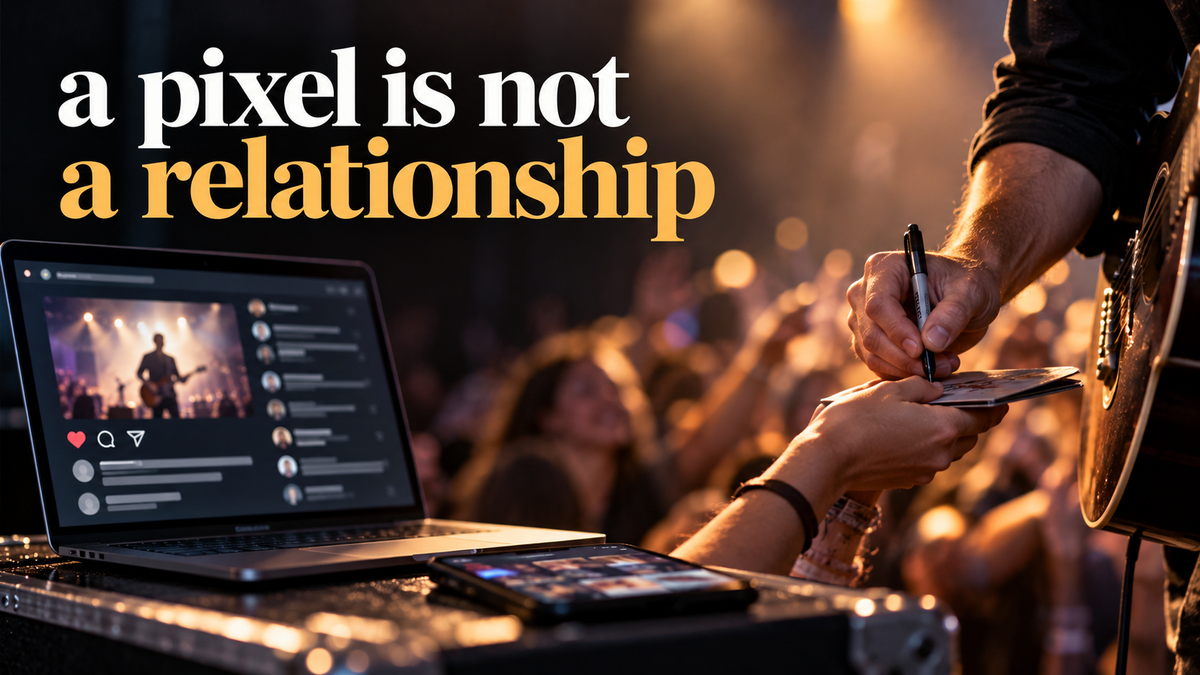
I have described this job as online brand management for most of my career, and it's the wrong name.
The brand is established offline. It's established by writing the songs, making the records, and walking onto a stage in a room with four thousand people in it, night after night, for thirty years. A website can express and extend that brand, but it does not create the underlying demand. Nor is it marketing, at least not as the term is normally used. The function I'm describing doesn't run the social channels — it asks for advertiser access to them. It doesn't create demand. At best it rides on marketing that the promoter and the label are already doing for reasons of their own.
So it's worth stating plainly what the job actually is, because there's a gap in how most artist teams are staffed and the vocabulary is part of why nobody notices it.
Everybody measures to the edge of their own system
Consider who is watching a tour announcement.
The promoter is measuring to the ticketing platform. Their data ends at the transaction on a system they don't own, and their interest ends when the show sells.
The label is measuring to the streaming link. They can tell you about plays and saves and playlist adds, which is a real business, and it's a different one.
The agency running the ads is measuring to the click. They can report impressions, cost per click, and — if someone put a pixel on the site — that some event fired afterward.
Every one of those parties can measure accurately within their own boundary, and usually stops at the edge of it. What they generally cannot see on their own is the complete economic record: whether a specific person completed a purchase, at what margin, having bought what before, and whether they came back.
That happens at the destination. And the destination is usually owned by nobody in particular.
What a pixel actually is
A pixel is a request to observe someone else's property. It's a courtesy, and it reports an event.
A pixel on its own can tell you that a purchase event occurred after a click. It does not contain the margin on that purchase, the buyer's history across three tours, or the customer record that tells you whether this was their twelfth order. Those things can be joined to advertising data, but only if the first-party transaction and customer record exists underneath it. The pixel is an observation layer. It is not the relationship.
All of that lives in a transaction record — one that has to be captured under your own entity, structured deliberately, and retained over years. An agency asking for a pixel is telling you, accurately, that it operates upstream and stops at the handoff. That isn't a criticism of agencies. It's a description of where their system ends.
Why the gap costs money rather than just clarity
Here's the practical consequence, and it isn't a measurement quibble.
If the only visible signal is clicks and engagement, spend drifts toward whatever produces clicks and engagement. Not through carelessness — through the ordinary operation of people optimizing against the number in front of them. Content that generates reach gets more budget. Audiences that click cheaply get more weight. If nobody in that loop can see the complete purchase record, they cannot see that one of those segments buys at four times the rate of the other.
Optimize against a proxy for two years and you will have built a machine that is extremely good at producing the proxy.
I've written before that measurement has become an expensive industry in its own right, and that a lot of what it reports is less incremental than it appears. This is the other half of that argument, and the two resolve together: measurement is only worth what it costs when it reaches all the way to money. Most of it stops well short, which is precisely why it's simultaneously expensive and unpersuasive.
What owning the endpoint requires
It isn't complicated, but it is a set of deliberate choices that have to be made before the traffic arrives, and most of them are unglamorous.
The site has to be under the artist's control, instrumented on purpose rather than inheriting whatever a theme shipped with. The commerce has to run under the artist's own merchant account, so the transaction record exists and the charge on the fan's statement reads as the artist. The transactional and marketing email has to come from the artist's domain, so the message and the purchase are the same relationship rather than two unconnected events. Customer service has to be branded and staffed, because the exception is where the record either gets corrected or gets corrupted.
Get those in place and the click from a social ad can be followed to the landing page, to the cart, to the completed order, to the margin, to the customer's history, and to whether they bought again eighteen months later. Not through attribution modelling. Through the actual record of what happened.
The name for it
This is not brand management and it is not marketing. It's operating the artist's online business — the infrastructure, the commerce, the customer relationship, and the measurement that connects them.
It's also, structurally, the last link in a chain where everyone else's visibility ends. The promoter's marketing works better when the destination converts and can prove it. The label's campaign is worth more when someone can tell which parts of it produced buyers. The agency's ads get materially smarter the moment they can be optimized against revenue rather than clicks.
Without that link, the rest of the chain isn't useless. It is measured in pieces rather than economically measured end to end — and over enough quarters that tends to become ineffective, because nobody can tell which parts were actually producing buyers.
Most artist teams have someone doing every job in that chain except the last one.
Mass of Niches is about the structural economics and operating detail of the direct-to-fan business for established touring artists.